
When companies begin handling larger volumes of EPS or other foam waste, shredding and densification can easily be treated as the same step. After passing through a foam shredder or crusher, large foam pieces become smaller and easier to feed into downstream equipment. However, the material is still lightweight and contains a large amount of air. If the main problem is limited storage space or the cost of transporting loose foam over longer distances, shredding alone usually does not solve it.
A shredder, crusher and densifier therefore serve different purposes. Shredding prepares the material for handling and feeding, while densification increases its density. Whether both processes are needed depends largely on what happens to the foam after size reduction.
A Foam Shredder Makes Large Foam Waste Easier to Handle
Appliance packaging, furniture packaging, insulation boards and industrial foam offcuts can vary significantly in size and shape. Large packaging blocks or sheets may be difficult to feed directly into downstream equipment. A foam shredder or foam crusher [Internal Link: Shredder & Crusher product page] reduces this bulky material into smaller, more consistent pieces that are easier to convey, store temporarily or feed into the next stage.
Once shredded, foam can move more easily through pneumatic or mechanical conveying systems, while oversized pieces are less likely to cause unstable feeding. However, shredding does not significantly increase the density of the material. This is particularly important with EPS: even after a styrofoam shredder breaks it into smaller pieces, the loose material can still occupy considerable storage and transport space.
EPS Foam Compactor Video:
Why Is a Foam Densifier Needed After Shredding?
A foam densifier [Internal Link: Foam Densifier product page] or compactor performs a different job from the front-end shredder. Instead of simply reducing the dimensions of the waste, it converts loose foam into denser material that is easier to stack, store and transport.
For EPS, shredded foam can be processed by either hot-melt or mechanical compaction equipment. GREENMAX MARS hot-melt densifiers use heat and extrusion to turn loose foam into dense ingots, achieving volume reduction ratios of up to 90:1. GREENMAX APOLO foam compactors mechanically compress the material into dense blocks, with volume reduction ratios of up to 50:1. The appropriate method depends on the foam type, material condition, processing volume and where the compacted material will go next.
This is the practical difference between a shredder and a densifier: the shredder prepares the material at a manageable size, while the densifier addresses the large volume associated with low-density foam.
When Is a Foam Shredder or Crusher Enough?
Not every foam recycling operation needs densification after shredding. Some foam manufacturers, for example, can shred clean production offcuts and return the material directly to an internal production or recycling process. If the next stage only requires consistently sized feedstock, a shredder or crusher may already provide the necessary preparation.
The more useful question is therefore whether the shredded material is ready for its next destination. If it can be reused directly on site, adding a densification stage may offer little practical benefit. If the loose foam still needs to be stored in large quantities or transported to an external recycler, further volume reduction becomes much more relevant.
EPS Foam Compactor Video:
How Can a Foam Shredder and Densifier Work as One System?
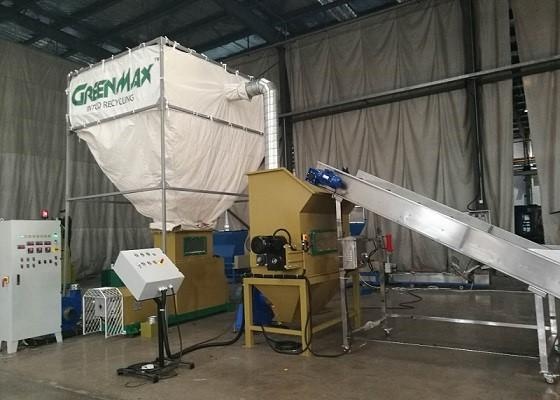
For smaller volumes and relatively consistent foam sizes, a machine with integrated crushing and densification can often handle the material without additional front-end equipment. As waste volumes increase, or when large foam pieces arrive in batches, feeding can become the limiting part of the process. Operators may spend more time moving and loading bulky material even when the densifier itself has sufficient processing capacity.
In these situations, an independent foam shredder or crusher can be added upstream. The shredded material can then be pneumatically conveyed to a storage silo and fed steadily into the densifier. This allows material receiving, shredding and densification to operate at different rates while reducing repeated manual handling.
There is no fixed combination of shredder, crusher and densifier that suits every project. GREENMAX can configure a standalone foam recycling machine or a continuous system combining shredding, conveying, storage and densification according to the foam type, original material size, waste volume, feeding conditions and downstream destination. The goal is not to add more processing stages, but to make each stage fit the way the foam is actually generated, handled and recycled.